 |
At this meeting we celebrated the birthdays of two of our members, Ken and Allen. Allen's mum provided a very appropriate and tasty cake - many thanks. |
This session we ballasted almost all of the track. We used the traditional method, spreading the dry ballast, then dampening it and finally dripping on dilute PVA. Here you can see the birthday boys, with Ken closely supervising Allen. |
 |
 |
Using a combination of two types of commercial ballast and some finely sieved soil from Andy's garden we managed all of the running lines, except the loco area and some of the timber yard. In this photo you can see thr transition between the main lines and the timber yard. |
Allen brought along his latest toy - a 1:1000 scale "train set" using a linear induction system. As you can see the control unit dwarfs the track and loco. Compare with the size of the timber branch gate in the background. |
 |
Sunday, 6 November 2011
Meeting - Sunday 6th November 2011

Sunday, 9 October 2011
Meeting - Sunday 9th October 2011
A truly momentous session today!
Unbelievably, we seem to have settled on the final track plan, and today we made the first tentative steps towards the scenics.
We replaced the old back-boards, which were riddled with access holes, with some new, plain boards using the 3mm MDF that Allen supplied. Then Ken painted the front faces of the backboards in a pale blue sky colour.
We began to fill in the timber-yard area, raising the ground level towards rail-level. At the next meeting we will be filling the area, burying the sleepers.
The first piece of "3D" scenery appeared near the timber-yard entrance. This hillock hides the complex set of micro-switches that switch the power in the three-way turnout.
The tasks for our next meeting are:
Unbelievably, we seem to have settled on the final track plan, and today we made the first tentative steps towards the scenics.
We replaced the old back-boards, which were riddled with access holes, with some new, plain boards using the 3mm MDF that Allen supplied. Then Ken painted the front faces of the backboards in a pale blue sky colour.
 |
"Yellow Peril" poses in front of the newly painted back-scene. |
We began to fill in the timber-yard area, raising the ground level towards rail-level. At the next meeting we will be filling the area, burying the sleepers.
The first piece of "3D" scenery appeared near the timber-yard entrance. This hillock hides the complex set of micro-switches that switch the power in the three-way turnout.
Y.P. passes our first "hillock". |
 |
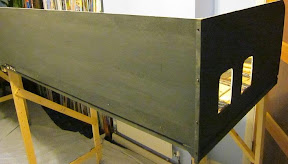 |
To prevent the back-scene sheets from warping, we painted the back of them in matt black. |
The tasks for our next meeting are:
- Cover the rest of the point motors (more hillocks)
- Begin ballasting
- Prepare bases and card mock-ups for the proposed buildings
Monday, 19 September 2011
Meeting Sunday 18th September 2011
This weekend Anderton returned from its Summer vacation on the sun-kissed shores of Birmingham. Whilst away Allen and Andy had done some tweaking, including sorting out the uncoupling magnets.
Then we noticed that the front line of the turn table could be extended to link up with the rear timber branch. This means we can drive loaded wagons of rough-sawn logs into the timber buildings, unload off scene and bring out planed boards.

The two rear timber-yard lines were raised and re-layed. The rearmost one runs sinuously through to the new fiddle yard; the middle line tries to run parallel to it.
So the track layout is finally completed...... until the next meeting!
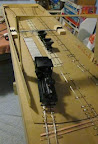 |
Andy has made a new fiddle yard/turntable for the Station end of the layout. It is made from 3mm MDF, so is very light weight, but sturdy. There are 3 tracks on the turntable, each split into 2 sections. |
We connected the fiddle yard and added an end board to hide it. The main line onto the turntable connects with the rear, station line of the layout, so the fiddle yard is aligned to the back edge of the layout and leaves a place for the operator working the timber-branch to stand. |
 |
Then we noticed that the front line of the turn table could be extended to link up with the rear timber branch. This means we can drive loaded wagons of rough-sawn logs into the timber buildings, unload off scene and bring out planed boards.
The two rear timber-yard lines were raised and re-layed. The rearmost one runs sinuously through to the new fiddle yard; the middle line tries to run parallel to it.
So the track layout is finally completed...... until the next meeting!
Saturday, 23 July 2011
Meeting 23rd July 2011
At today's meeting Allen and Andy finished installing the mark 2 turnout motors. We also replaced the control arms on the first batch with the new improved strengthened versions. Allen is now selling the turnout system as a kit - check it out at the Minimum Gauge Models stand at your next Narrow Gauge exhibition.
We discovered a small problem with our uncoupling magnets. We have used pairs of small "rare-earth" magnets, with their tops level with the sleepers, to operate the KD couplings. They work fine with the bogie stock, but when we tried to reverse some standard Bachmann V-skips over the magnets they proved too strong and tipped the skips.
The problem seems to be that the V-skips have a very short wheelbase, but a long overhang to the coupling pin. The magnets make the wagon pivot on the front axle.
So, sorting out the magnets is our next priority.
And then Andy started planning another extension to the layout.....
 |
Peter had finished the improvements to the turntable to sort out the warping of the deck. |
 |
The turntable is aligned by a single bull-dog clip which bridges the angled aluminium strips |
Several months ago Ken built a really lovely three-way point for the timber-yard sidings, but the complexity of it has meant that it is rather fragile - it is difficult to strengthen, so reluctantly we have decided to replace it with teo separate turnouts. |
 |
We discovered a small problem with our uncoupling magnets. We have used pairs of small "rare-earth" magnets, with their tops level with the sleepers, to operate the KD couplings. They work fine with the bogie stock, but when we tried to reverse some standard Bachmann V-skips over the magnets they proved too strong and tipped the skips.
 |
The problem seems to be that the V-skips have a very short wheelbase, but a long overhang to the coupling pin. The magnets make the wagon pivot on the front axle.
So, sorting out the magnets is our next priority.
And then Andy started planning another extension to the layout.....
Tuesday, 12 July 2011
Developments in January - June 2011
The first half of 2011 saw the completion of the fiddle-yard and our first chance to set-up the entire layout. Testing and tweaking of track-work and wiring has occupied most of our time. Once we were happy with this we built integral legs for the layout and retired the Dexion supports.
Just as we thought all was settled, Allen turned up with his "mark-2" servo system for the turnout controls. This is a very-professional looking system, with an excellent etch, so we embarked on another set of changes.
Just as we thought all was settled, Allen turned up with his "mark-2" servo system for the turnout controls. This is a very-professional looking system, with an excellent etch, so we embarked on another set of changes.
Developments during 2010.
Our first exhibition at Mickleover allowed us to identify areas for improvement on the layout, including:
Since our turnouts are land-made we needed a method for locking them in route. Allen devised a servo-operated system and produced etched parts to operate them. He also produced our central control board, by re-cycling an unwanted industrial control box and adding an exquisite etched panel. We also took the opportunity to completely revise the wiring of the boards, simplifying them in the process.
Finally a new fiddle-yard was built incorporating a 5' long, 5 track turntable. We have a lot of odd-ball locos, so the central track is split into 6 sections, so that we can store a selection of locos on it.
We returned to the Mickleover exhibition in January 2011 (although the fiddle-yard was not quite ready) which gave us the chance to really test out the new track.
- Improving the track layout in the timber yard; this included building a three-way turnout to give us three sidings and adding a head-shunt for the yard loco.
- Centralising the turnout controls. Our first version had manually operated "wire-in-tube" turnout controls. Although these worked very well the operators had to move from board to board to set routes and reaching some of the more distant controls was difficult.
- Change the fiddle-yard from cassette-based to a large turntable.
Since our turnouts are land-made we needed a method for locking them in route. Allen devised a servo-operated system and produced etched parts to operate them. He also produced our central control board, by re-cycling an unwanted industrial control box and adding an exquisite etched panel. We also took the opportunity to completely revise the wiring of the boards, simplifying them in the process.
Finally a new fiddle-yard was built incorporating a 5' long, 5 track turntable. We have a lot of odd-ball locos, so the central track is split into 6 sections, so that we can store a selection of locos on it.
We returned to the Mickleover exhibition in January 2011 (although the fiddle-yard was not quite ready) which gave us the chance to really test out the new track.
Friday, 8 July 2011
Mickleover exhibition 2010

Our friends from the Trent Valley group of the 7mm NGA invited us to show Anderton at their member's day in January 2010 at Mickleover. As you can see the layout was in a very basic state at the time.
You can see here the Dexion framework in which the boards sat.

The mark 1 fiddle-yard was tried out for the first time. It used cassettes, but we found their size made them unwieldy and made plans to change to a turntable version.

Thanks to the Trent Valley group for giving us a chance to take Anderton out for the first time and for their encouragement. Their exhibition is a really friendly event, with lots of chances to talk "narrow gauge" with like-minded colleagues.
Henmore Vale makes its annual outing and there are other selected layouts and demonstrations. And the bacon sandwiches are brilliant as well!


At the close of the show they invited us to bring Anderton back the following year. It sounded great, until we realised that, since we meet just once a month, we only had "12 days" before the next exhibition.
Subscribe to:
Posts (Atom)